Altitude changes the leak equation
Highlands sits at nearly 4,000 feet, placing it among the highest incorporated towns in the eastern United States, and that elevation rewrites the standard leak-detection playbook. Pools here cycle through genuine freeze-thaw stress every winter, not the occasional hard frost that Piedmont pools might see once or twice a season. A fitting that holds fine at lower elevations can crack open after repeated hard freezes, and a plumbing line that drains clean in Charlotte may hold a pocket of trapped water in a Highlands slope yard that refreezes before dawn.
The other variable is rainfall. Macon County's high plateau pulls in some of the heaviest annual precipitation east of the Cascades, and rain arrives consistently enough to top off a pool surface at the same time water is escaping through a hidden crack. The water level stays steady; the loss goes unnoticed for weeks. For owners who arrive in June to open a pool that has been closed since October, that diagnostic gap is often why the leak has been running — quietly and invisibly — for an entire shoulder season. If you are watching your pool and cannot tell whether it is losing water to evaporation, rain, or a real leak, you are dealing with the specific challenge that makes Highlands pool work different from anywhere else in North Carolina.
Where freeze-thaw damage shows up
Most Highlands pools sit winterized from late fall through spring, and most leak calls arrive within the first week of reopening. After months under a cover, a few things will look like a leak that are not: normal evaporation on warm spring afternoons, minor backwash from a first filter run, or cover condensation draining into the pool. The tells that signal a real problem are distinct: water level dropping more than a quarter inch per day on a calm, dry day; wet soil near the equipment pad during a dry spell; a persistent soft spot in the deck surface; or a crack in the shell that was not there last fall.
Freeze-thaw damage concentrates at points of differential movement: skimmer faceplates, where the plastic contracts differently from the shell around it; fittings where plumbing meets the pool wall; and return lines that cross the frost line in a slope yard. A pool that holds water through summer but drops every spring is almost always carrying damage that formed over the previous winter. Each season it goes unrepaired, the movement opens the crack further. A repairable crack in April is an excavation job by September.
Detection scope and cost in Macon County
The full cost guide covers service-by-service ranges for the region. The working table for Macon County jobs:
| Service | Typical Range |
|---|---|
| Pressure test — plumbing lines only | $100 – $200 |
| Electronic or acoustic detection — full pool | $200 – $500 |
| Skimmer, fitting, or return repair | $150 – $400 |
| Plumbing line repair (accessible section) | $300 – $800 |
| Shell crack injection or surface patch | $100 – $600 |
| Structural shell or bond beam repair | $1,500 – $5,000+ |
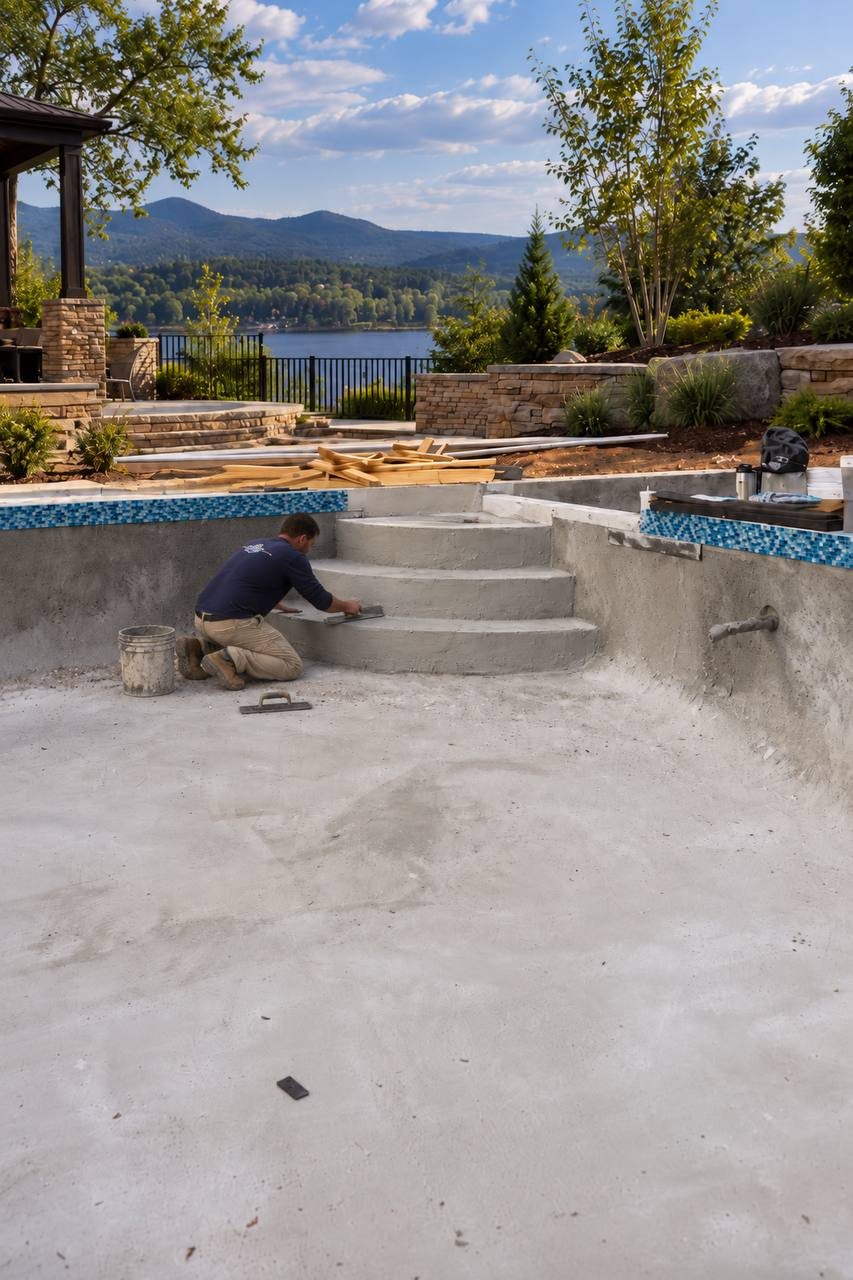
Slope lots add cost to any excavation work. A line leak on a flat yard in Franklin is a straightforward dig; the same leak on a terraced Highlands property may require cutting through landscaping or a retaining wall before the first repair can begin. Structural findings on steep terrain reach the upper end of the table and may involve a separate site contractor for access work. Get a written scope, not just a number, before work starts on anything beyond a simple fitting repair.
The second-home gap
Highlands has one of the highest concentrations of second and seasonal homes in western North Carolina, and that creates a pool problem that does not exist in most markets: the winter leak that ran for months before anyone saw it. A pool that lost water steadily from November through April will look normal when the cover comes off, because the owner refilled it at opening. The damage surfaces later — a crack wider than last year, a fitting that failed silently, a retaining wall with new staining at the base.
15 federal disaster declarations touch Macon County across 1973-2026, the majority storm and flood events. Those events pushed water at pool structures and equipment pads when no one was present to notice. A pool that survived the summer before a severe winter may have taken frost or storm damage the owner never saw. Early-season leak detection before refilling costs less than the water bill for a summer of steady loss, and far less than the structural repair that waits at the end of one. Catching a failing skimmer in April is a fitting job; finding it after the deck has settled around a saturated soil zone is an excavation job.
Hiring correctly for mountain pool work
Pool repair in North Carolina sits under licensing and code requirements that depend on what is being done and what type of pool it is. Commercial, resort, and club pools — a category with real presence in Highlands — operate under water safety and construction rules administered by the NC DHHS Environmental Health Section, which governs pool construction, repair standards, and water quality for facilities open to the public. Residential structural repairs that cross certain scope or dollar thresholds trigger building code review under the NC Department of Insurance Building Code Council. Knowing which framework applies before hiring protects you if a repair requires a permit.
For detection method, the Pool and Hot Tub Alliance (PHTA) publishes professional standards distinguishing pressure testing, dye testing, and acoustic or electronic methods. Which approach is appropriate depends on the pool's construction type — a vinyl liner pool and a gunite pool fail in different places and require different detection passes. Ask any prospective crew which method they plan to use and why it fits your pool. A crew that jumps to an excavation quote before completing a non-invasive diagnostic pass is not running the method that protects your budget on a mountain property.