Hillside Asheville and the license line most contractors cross
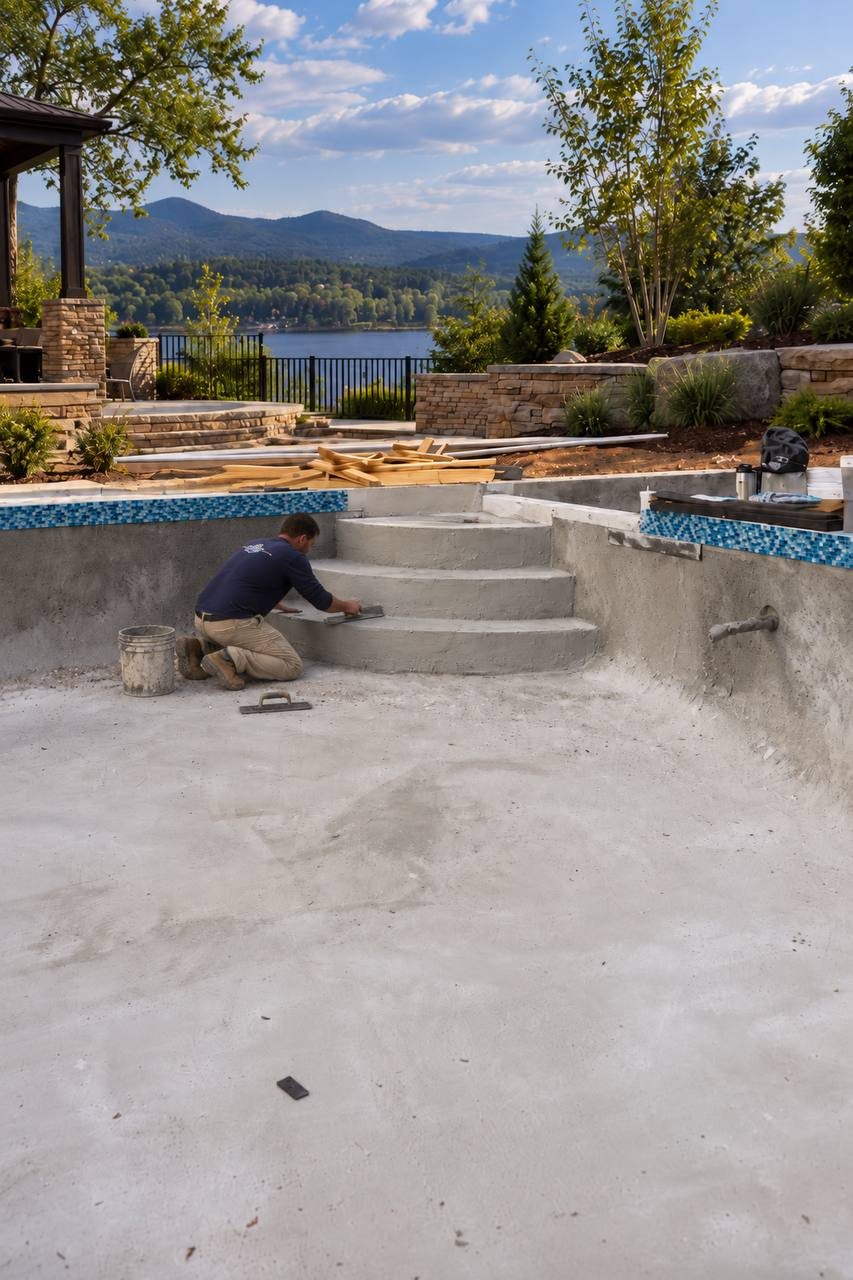
Buncombe County pools are not like flat-county pools. Asheville and its surrounding mountain communities — Weaverville, Black Mountain, Swannanoa, Fairview — sit on slopes where a pool renovation can mean cutting into grade, tying into a retaining wall, or augering through bedrock before a single tile goes in. Those conditions are also why the nc pool contractor license question lands differently here: terrain drives costs up fast, and once the total contract value clears $40,000, North Carolina law requires the contractor holding the prime contract to carry a General Contractor license from the NC Licensing Board for General Contractors.
North Carolina does not issue a separate pool-trade license. What it issues instead is a licensing structure organized by trade and dollar threshold — which means homeowners need to know which licenses apply to which piece of the work. The table below maps common renovation scopes:
| Work scope | License required |
|---|---|
| Total contract under $40,000 | No GC license required; plumbing and electrical subs must still be independently licensed |
| Total contract over $40,000 | Licensed General Contractor required on the prime contract |
| Plumbing (equipment room, return lines, main drains) | Licensed Plumbing Contractor required regardless of project total |
| Electrical (bonding, lighting, pump circuits, GFCI) | Licensed Electrical Contractor required regardless of project total |
| Commercial, HOA, or public pool renovation | GC license plus NC DHHS public pool rules apply separately |
Three separate credentials behind every pool renovation
Even when a project falls below the GC threshold, two licensed trades are required for virtually every pool job in North Carolina: plumbing and electrical. A licensed plumbing contractor must handle the pool's piping, equipment pad connections, and drain systems. A licensed electrical contractor must perform bonding, grounding, pump circuit wiring, and any lighting installation — requirements driven by the lethal hazard that energized equipment creates around water. These trade licenses are not optional and apply regardless of who holds the prime contract or what the project total is.
For a complete pool renovation in Buncombe County — resurfacing, new equipment, coping, tile, and updated plumbing — the plumbing and electrical scopes together typically run $8,000–$20,000, depending on equipment selection and the complexity of the equipment room layout. On a hillside lot where the equipment pad sits uphill from the pool and run lengths are longer, that range tends toward the higher end. When those trade costs fold into the total contract alongside structural and resurfacing work, clearing the GC licensing threshold is the rule rather than the exception for full renovations in western NC.
Ask each contractor not just "are you licensed?" but for their license type and license number, then confirm each on the relevant state board's public lookup tool. A GC license does not automatically cover the plumbing scope; each trade's credential must be verified separately. A contractor who proposes to self-perform the electrical bonding without a licensed electrical subcontractor is in code violation regardless of their GC license status.
HOA and public pools answer to a different rulebook
If you are renovating or managing a pool for an HOA community, apartment complex, hotel, or any facility open to more than a single household, a second regulatory layer applies on top of the contractor licensing requirements. The NC DHHS Division of Public Health, Environmental Health Section maintains pool and spa rules under 15A NCAC 18A .2600, covering water quality parameters, recirculation and filtration standards, bather load calculations, and drain cover compliance under the federal Virginia Graeme Baker Pool and Spa Safety Act.
For any renovation at a public or semi-public pool in Buncombe County, the process includes a plan review by the county environmental health office before construction begins and a re-inspection before the facility opens after renovation. Contractors working in this lane need their GC license and must demonstrate familiarity with public pool code requirements — the residential code that governs a private backyard pool in Swannanoa is not the same document that governs the community pool at a neighborhood association. For private residential pool resurfacing at single-family homes, the public pool rules do not apply, but the trade licensing requirements remain the same.
How the $40,000 threshold is calculated — and why mountain jobs clear it
The $40,000 licensing threshold is measured against total contract value, not just the pool shell or equipment line items. In Buncombe County, that distinction matters. Excavation into weathered mountain rock, retaining wall modifications on a sloped lot, drainage corrections around the pool perimeter, and equipment pad construction on a hillside can each add thousands to the contract before a single coat of plaster is applied. Change orders are common on mountain lots: a project scoped at $35,000 that hits bedrock two feet below grade, requiring jackhammering or blasting, can cross the $40,000 line before surface work begins.
The precipitation patterns of western North Carolina compound this. Buncombe County has recorded 19 federal disaster declarations over 1973-2026, a history driven by the region's rain totals and the speed with which mountain terrain channels water downslope. Mid-renovation, drainage problems around a pool that appeared minor during the site assessment can surface as a meaningful structural correction — one that adds to the contract value and can change the licensing requirement mid-project. If a project is scoped anywhere in the $30,000–$50,000 range, confirm the contractor's GC license status before signing, not after a change order arrives.
The permit record and the licensing record are linked. A project that is permitted and then crosses the licensing threshold mid-job without the proper GC credential creates a gap in the inspection chain. For a full explanation of how permits and licensing records connect in Buncombe County, see NC pool permit requirements.
Where unlicensed work surfaces — three places that sting
The licensing and permit record for a pool renovation is part of the permanent improvement history of the property. Three points in that property's life where the record gets examined:
At resale: A buyer's inspector or their real estate attorney will look for a closed building permit tied to any major pool work. Unpermitted renovations performed by unlicensed contractors leave no permit record. In Buncombe County's competitive real estate market, that discovery during due diligence tends to reopen price negotiations or produce a credit request. The permit and the license verify that the work was done to code by someone accountable to a licensing board — that accountability is yours to demand before the contract is signed, not after it surfaces at the closing table.
At the insurance office: A claim for pool damage adjacent to undocumented work invites scrutiny. An adjuster reviewing a structural failure claim who finds no permit record for the renovation that preceded it has grounds to investigate whether the work met code. The NC Department of Insurance administers the state building code system in which that permit record lives; unlicensed work has no inspection trail through that system.
At refinance or appraisal: Unpermitted pool modifications can affect appraised value and create complications for conventional and FHA loan underwriting. An appraiser who flags the gap does their job correctly; the homeowner absorbs the consequence. The most cost-effective time to get the licensing and permit record right is before the work begins — not during a thirty-day closing window.