Altitude changes what holds and what fails
Highlands sits at roughly 4,118 feet above sea level — one of the highest incorporated towns in the eastern United States. That elevation is the first thing a Highlands pool deck owner needs to understand before choosing a surface, because freeze-thaw cycles here are real, repeated, and hard on poured concrete in a way a contractor from the Piedmont or the coast will not necessarily warn you about. Water enters a micro-crack in a concrete deck surface, freezes overnight, expands, and opens the crack slightly; that cycle runs dozens of times each winter at this altitude. On a flatland NC deck it matters less; here it is the primary failure mechanism.
Macon County's rainfall record makes the picture more complicated. Highlands is one of the wettest places east of the Mississippi, with annual totals regularly approaching 90 inches. The federal disaster record for Macon County reflects 15 declared events spanning 1973-2026, most of them storm and water events. That rain does not just fall on the deck; it moves under it, around it, and through it. A pool deck at this elevation is not simply a decorative surface — it is a drainage structure that needs to be treated like one.
If your property is a seasonal second home, the problem compounds. Decks that sit unwatched from late fall through early spring absorb water, freeze, thaw, and crack without the early intervention that prevents a $600 repair from becoming a $6,000 one. The pool renovation overview covers the full picture when a deck problem is part of a larger pool overhaul.
Surface finishes and how each one performs at elevation
A concrete overlay at $3 to $10 per square foot is the entry-level option. It bonds to an existing sound deck, costs the least, and can be recolored. At this elevation, though, the sealer that protects it needs attention every two to three years rather than the five-year cycle you might see in the Carolina Piedmont — a maintenance commitment that matters for second-home owners who are not on site to notice when it begins to fail. Standard broom-finished overlays provide adequate slip resistance when new; once surface texture wears, the drainage and slope of the deck do more work than they would in a drier climate.
Stamped concrete at $8 to $20 per square foot adds detail and visual weight but requires equal or greater sealer discipline. The texture of a stamped pattern holds some slip resistance, but the sealant is what keeps water from working into the pattern seams. Skipped maintenance seasons accelerate the failure timeline noticeably at this altitude.
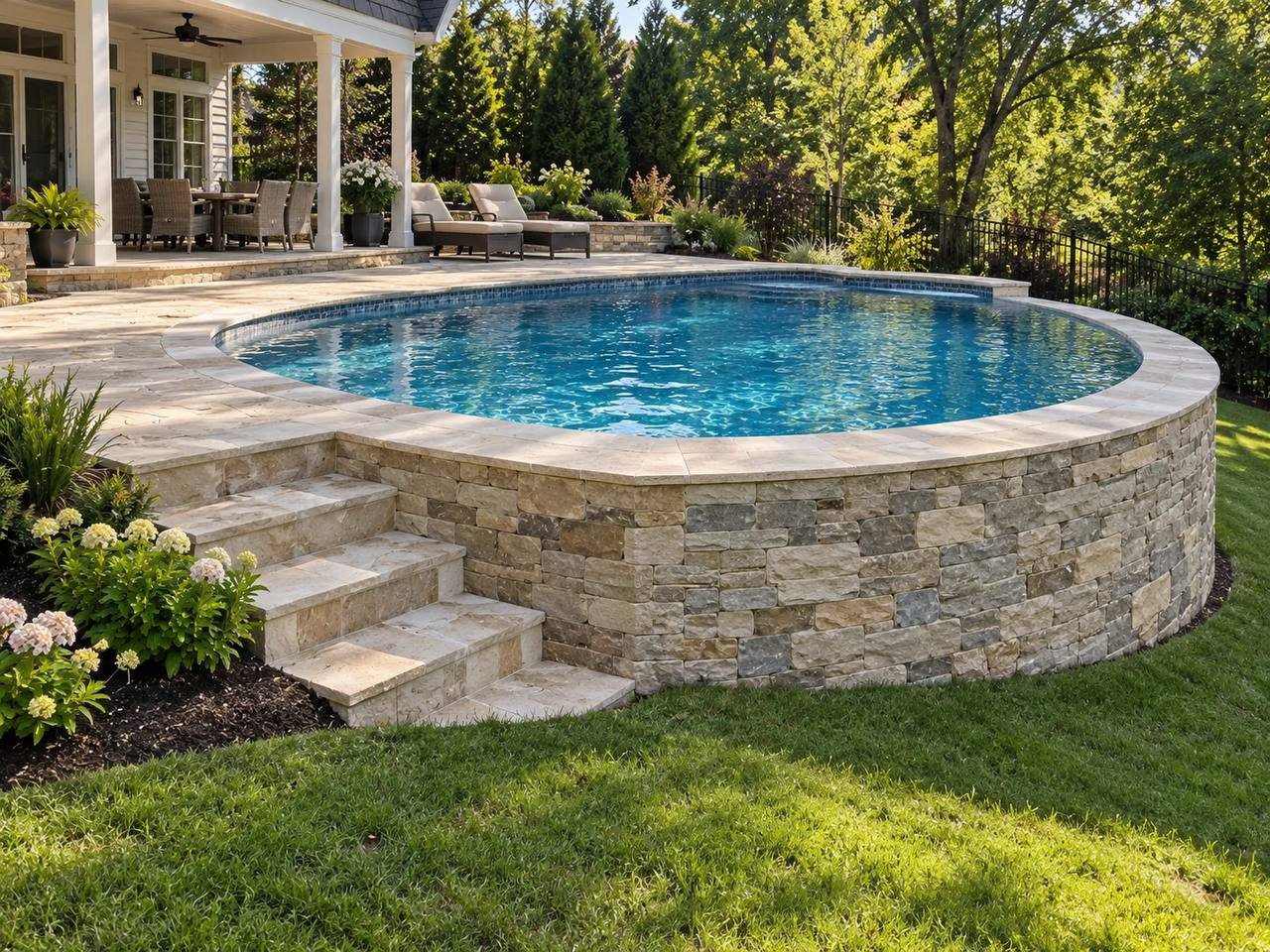
Travertine and natural stone pavers at $15 to $27 per square foot installed are the material that performs best in Highlands over a long ownership horizon. Individual pavers replace without demolishing the whole deck, the natural pore structure tolerates freeze-thaw better than poured surfaces, and the inherent texture meets slip-resistance guidance without a coating. That slip rating matters: the Pool and Hot Tub Alliance recommends a minimum coefficient of friction of 0.6 on wet pool deck surfaces, and at Highlands rainfall levels that threshold is routinely tested. The resurfacing overview walks through all three surface families in more detail.
What projects cost around Macon County
The table below covers typical scope-to-price ranges for Highlands area work. Access on steep or narrow lots and freight costs to a mountain location push most jobs toward the middle or upper half of each range; a flatland quote will almost always underestimate a Highlands project. See the full pool deck cost breakdown for line-item detail.
| Scope | Typical Deck Size | Price Range | Notes |
|---|---|---|---|
| Concrete overlay, standard finish | 400–600 sq ft | $1,200–$6,000 | Reseal every 2–3 yrs at this elevation |
| Stamped concrete resurface | 400–600 sq ft | $3,200–$12,000 | Sealer maintenance is non-optional here |
| Travertine or natural stone pavers | 400–600 sq ft | $6,000–$16,200 | Best freeze-thaw longevity |
| Repair existing damage before overlay | Per damaged section | $500–$2,500 added | Required before any new finish |
| Deck expansion or structural work | Varies | Permit required; varies by scope | Triggers Macon County building review |
Code requirements pool decks must meet in North Carolina
Resurfacing an existing pool deck to the same footprint generally does not require a permit in Macon County, but any structural repair, drainage modification, or expansion of the deck area typically does. The NC Department of Insurance Building Code Council sets the residential construction standards that govern decks adjacent to pool structures, and Macon County enforces those requirements at the permit counter in Franklin. When work crosses into structural territory, pull the permit — an uninspected deck modification can complicate a property sale or insurance claim faster than the permit would have cost.
For pools classified as semi-public — any pool serving more than a single-family household, including some short-term rental properties in the Highlands rental market — the NC DHHS Environmental Health Section imposes specific deck surface and drainage requirements, including minimum deck width around the pool edge and required drainage slopes. If your Highlands property rents on any platform, confirm your pool classification with the county environmental health office in Franklin before choosing a surface or signing a contract.
Three questions that sort out the right contractor
Highlands-qualified crews separate quickly on three points. First: have they worked on pool decks at elevation before? Freeze-thaw behavior changes mix design choices, substrate prep requirements, and sealer product selection. A contractor whose reference pools are in Asheville or Brevard is better suited than one whose only mountain experience is a driveway job in Sylva. Second: how do they handle drainage design? On a sloped lot in a 90-inch-rain climate, the surface itself needs to direct water away from the pool edge and the house foundation — not just appear flat when dry. Third: what sealer product and maintenance cycle are they specifying? The answer should be climate-specific, not a default from a product sheet.
For projects that include structural work or drainage modification, ask whether a soil review is in scope. Macon County lots in the Highlands area often sit on shallow mountain soil over rock, and footing conditions affect how a deck behaves over years of freeze-thaw cycling. When in doubt about whether you need a resurface or a more involved renovation, the pool renovation guide covers that decision in full.